Buyer's Guide
How to Choose an Abaya Manufacturer: A Checklist for Boutiques and New Brands
Last updated —8 min read
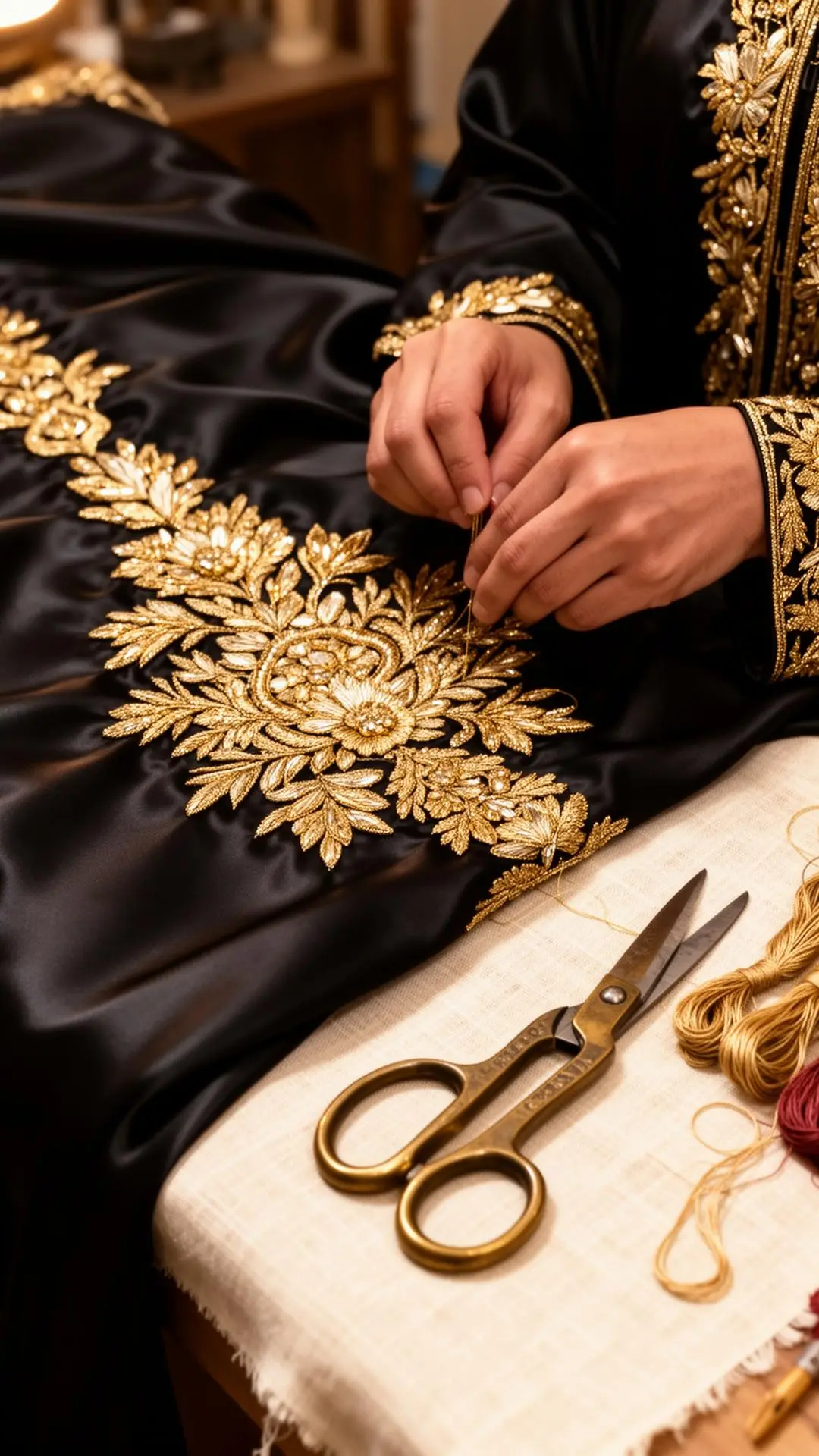
Most abaya brands do not fail on design. They fail somewhere between the reference picture and the finished garment: a minimum order they could not sell through, a lace that turned out not to exist, a delivery that arrived after the season it was meant for. Almost all of that can be avoided by asking the right questions before the first order, rather than learning the answers from the first delivery.
This checklist is written for boutique owners and people starting a brand. It is the same list whether you order from us or from anyone else, and it is deliberately written so that a good manufacturer will be glad you asked.
This is the first question because it shapes every answer after it. A factory cuts and sews the garment itself. A trading company takes your order and places it with a factory you never speak to. Neither is automatically bad — some trading companies manage production well — but they behave differently when something needs to change.
With a factory, a question about a seam allowance or a sleeve length is answered by someone who will actually sew it. With a trading company it is relayed, and details get lost in the relay. Ask directly: do you cut and sew in-house? Where? Can you show me a video of production? A factory will answer all three without hesitation.
A minimum order quantity (MOQ) can be quoted per design, per colour, or per order, and the difference is large. A minimum of 50 per order spread across five designs is a very different commitment from 50 per design. Always ask which it is.
The per-design minimum is the number that matters for a new brand, because it decides how many designs you can test with the money you have. A low per-design minimum lets you learn which designs sell before you commit to volume. Our own minimum is 8 pieces per design, and we explain why low minimums matter in more detail in our guide to abaya MOQs.
This is where most disputes in abaya production start. The majority of lace, trims and embellishments are bought from the market rather than woven or made to order — nobody mills a bespoke lace for a small run. That means a design with a specific lace can only be made if that lace, or something genuinely close to it, can be bought.
A good manufacturer will tell you, before production, if a trim in your reference cannot be sourced, and show you the nearest real alternative. A poor one substitutes quietly and you find out when the parcel arrives. Ask the question outright: if you cannot find this exact trim, what happens?
Large factories often require a technical pack — measured drawings, specifications, a bill of materials — before they will quote. That is reasonable at volume and a real barrier for a founder with a folder of screenshots. Many abaya manufacturers will work from a photo or a video instead, and handle the pattern themselves.
One practical point: send the back. Abaya back drape and embroidery placement often differ from the front, and a front-only reference leaves the most expensive decisions to guesswork. Be cautious, too, with AI-generated design images. They are useful as direction, but they can show construction that cannot actually be sewn — a manufacturer should tell you what has to change.
Ask for these as two separate numbers. "Three weeks" can mean three weeks to finish sewing or three weeks until the parcel is at your door, and the gap between those can be a fortnight. Then work backwards from the date you need stock on the rail, and leave a margin — especially before Ramadan and Eid, when every manufacturer is busy at once.
If you are building a brand, ask exactly what private-label options exist: woven labels, printed labels, leather labels, hangtags, packaging. Ask whether care and fibre-content labelling can be printed to your wording, because several markets have legal requirements for it. Our guide to private label labelling covers the options and the rules in more detail.
The unit price is not your cost. Your cost is the unit price plus labels, packaging, shipping, and whatever duty and tax your country charges on import. Ask for a landed-cost figure for your specific order and destination. Be wary of anyone who quotes you a duty rate from memory — rates depend on the product's classification and change over time, and the authority in your country is the only reliable source.
| Question | Why it matters | NAH's answer |
|---|---|---|
| Factory or trading company? | Decides who answers questions and what can change | Factory — we design, cut and sew in-house in Ajman, UAE |
| Minimum per design? | Decides how many designs you can test | 8 pieces per design |
| How are trims sourced? | Most disputes start here | Bought from suppliers; we confirm a trim exists before production |
| Photo, or tech pack? | A tech pack is a barrier for new brands | A photo or video is enough |
| Production time? | Separate from delivery | 1–3 weeks, depending on volume and complexity |
| Delivery time? | Separate from production | Worldwide, 10–15 days |
| Private label? | You are building a brand, not reselling one | Woven labels, leather labels, hangtags; packaging boxes provided |
| Fabric range? | The main lever on cost | Tiers from the most premium in the region down to upper-mid |
| Samples? | Test before committing | Ask us when you enquire |
| Mix sizes within the minimum? | Affects how you build a size run | Ask us when you enquire |
| Landed cost? | Unit price is not your cost | We quote a landed cost for your order and destination |
| How do I order? | Speed of communication matters | WhatsApp or email |
It sounds like questions coming back at you. A manufacturer worth working with will ask about your market, your price point, your customer and your deadline before quoting — because each of those changes the right fabric and the right quantity. A quote that arrives instantly, without a single question, usually means nobody has thought about your order yet.
And it sounds like being told no. If a design will not hang properly in the fabric you asked for, or a trim cannot be found, you want to hear that before you pay. The cheapest manufacturer is rarely the one with the lowest unit price; it is the one whose first delivery you can actually sell.
See how we work — minimums, lead times, private label and how to send a design.
Wholesale & manufacturing
What a minimum order quantity is, why manufacturers set one, and how a low MOQ changes the risk of starting a boutique or brand.
What each kind of label does, when to use it, and the labelling rules several markets require by law.
The general principles of importing abayas — duty, import tax, classification, who pays and where to check — with links to the official customs authority for each market.